
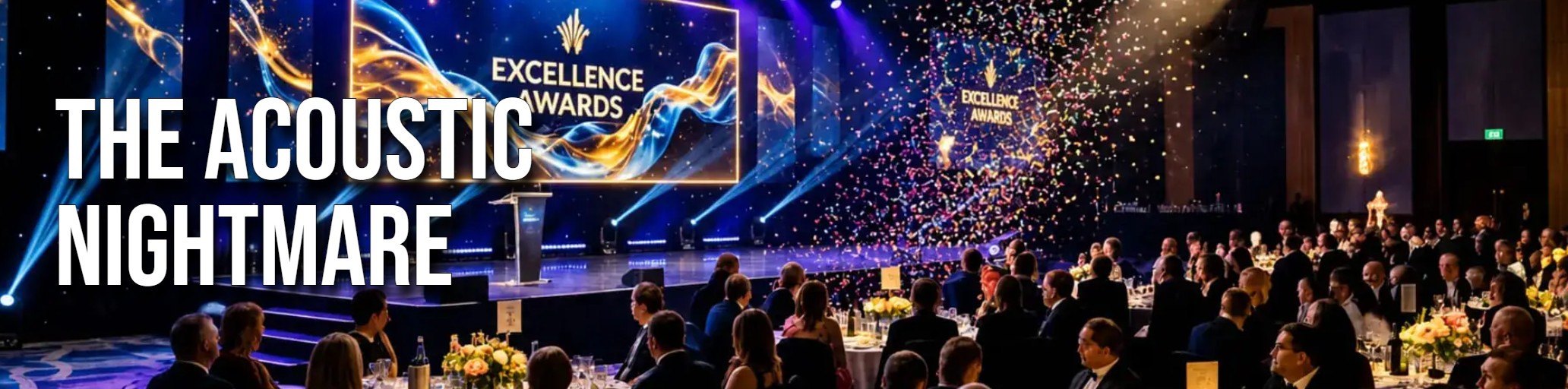
Architecturally, Dubai features some of the most breathtaking event spaces on the planet. From sleek Downtown high-rises with floor-to-ceiling glass to opulent luxury hotel ballrooms paved in polished Italian marble, the visual impact of these venues is undeniable.
However, from a sound engineering perspective, glass and marble are an absolute nightmare.
Both materials have a near-zero sound absorption coefficient, meaning acoustic waves don’t get absorbed—they bounce back into the room instantly, creating severe reverberation, flutter echoes, and muddy frequencies. When a high-profile corporate speaker talks into a microphone or a DJ in Dubai drops a heavy track, the audio turns into a wall of harsh noise where speech becomes unintelligible and bass loses all definition.
If you are planning an upcoming luxury event in a hard-surface venue, here is how professional audio/visual services defeat acoustic echo without compromising your venue’s aesthetic.
1. The Science of the “Echo Chamber”
When sound waves hit a hard surface like glass or polished stone, up to 99% of the sound energy is reflected back into the room.
The Problem: In large, high-ceiling spaces, this causes a long RT60 (Reverberation Time)—the time it takes for sound to fade away.
The Result: The late reflections collide with the fresh sound coming out of the speakers. The crowd struggles to hear speeches clearly, forcing the technician to turn the volume up, which only makes the echo worse.
2. Acoustic Fix #1: Line Array Dispersion & Point-Source Delay
The biggest rookie mistake in a highly reflective room is placing two massive speakers at the front of the stage and blasting audio at full volume.
Line Array Systems: Professional event management UAE teams utilize vertical line array speakers. Line arrays deliver narrow vertical coverage and wide horizontal dispersion, directing sound directly at the audience’s ears while avoiding the reflective floor and ceiling.
Delay Towers / Distributed Audio: Instead of relying on one ultra-loud sound source, technicians set up smaller “delay speakers” throughout the venue. This keeps the overall Sound Pressure Level (SPL) lower and consistent across the room, preventing excessive reflections.
3. Acoustic Fix #2: Strategic Acoustic Treatment (Discreet Draping & Pipe)
You don’t have to ruin a luxury ballroom’s aesthetics with ugly acoustic foam.
Heavy Velour Drapes: Placing high-density acoustic drapes behind the stage or along vast glass walls breaks up reflections and acts as a massive acoustic sponge.
Soft Furnishings & Carpeting: Introducing thick carpet runs, soft lounge seating, and fabric backdrops absorbs high frequencies right at eye level, dramatically lowering the room’s overall echo.
4. Acoustic Fix #3: Digital Frequency Tuning (DSP & EQ Calibration)
Before the first guest steps into the venue, a proper sound team calibrates the system using digital signal processors (DSP) and real-time analyzers (RTA).
Notching Out Problem Frequencies: Hard surfaces tend to amplify harsh mid-range frequencies (around 1kHz to 4kHz) and trap boomy low-end bass in room corners.
Surgical EQ: By applying precision parametric EQ cuts to the master output, an experienced audio engineer removes the exact frequencies causing room resonance, restoring crystal-clear vocal clarity and tight, punchy bass.

Flawless events require more than just loud speakers—they require precise acoustic engineering. Karan Joseph Cliff combines a classical music background from Trinity College London with over 15 years of live DJ performance, music production, and comprehensive audio/visual services and event management UAE. We evaluate every venue’s unique acoustic footprint to guarantee your guests hear every note, speech, and beat with absolute clarity.
[Contact Our Technical Production Team to Map Your Venue Acoustics Today]